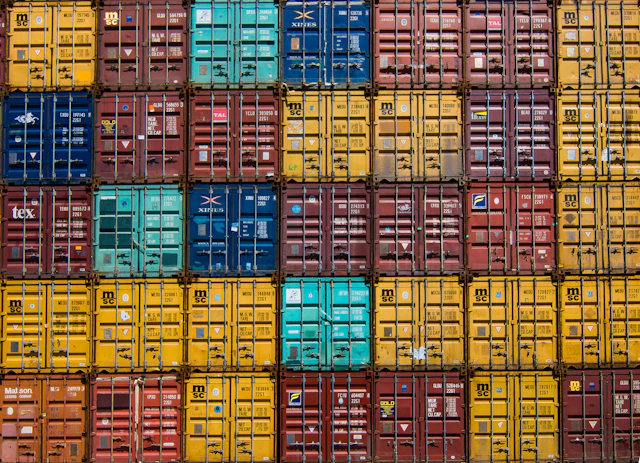
Choosing how to move cargo from China to Europe comes down to volume, budget, deadline and the nature of the product. China Aurora arranges sea and air freight along with other international transport options, and can organise door-to-door movements depending on the destination.
Sea freight
Sea freight is the default for large shipments, containers and production lines. FCL or LCL is chosen by volume, and transit times differ according to origin port, destination port and shipping line.
Rail freight
Rail between China and Europe can be a middle option for shipments that need to move faster than sea without paying for air. Actual service availability and transit time vary by route, train service and terminal.
Air freight
Air suits urgent parts, samples, electronics and higher-value goods where speed matters more than transport cost.
EORI and CE marking
An EORI number is used for customs transactions within the EU. CE marking is not a general certificate covering every product — you first need to establish whether the product falls under legislation that requires CE marking and the associated technical documentation.
CBAM
Certain categories of goods imported into the EU may fall within the scope of the Carbon Border Adjustment Mechanism. Whether the product and the commercial arrangement are in scope should be determined before shipping, rather than assuming the requirement applies across the board.
Frequently Asked Questions
Is rail always faster than sea?
Not on every route. The specific corridor, the available schedule, clearance time and inland transport all have to be compared.
Can you arrange door-to-door shipping from China to Europe?
Yes. Sea, rail or air can be arranged depending on the project and destination.
Does every product need CE marking?
No. It depends on the product category and the EU legislation that applies to it.