Buying Used Heavy Equipment from China: The Complete Inspection & Sourcing Guide
· Aurora Trading
A used excavator from China can cost far less than a new one, but only if you know exactly what you are buying. This guide explains how Guangzhou Aurora Trading inspects, verifies and ships used heavy equipment, using real photos and findings from our own inspection reports.
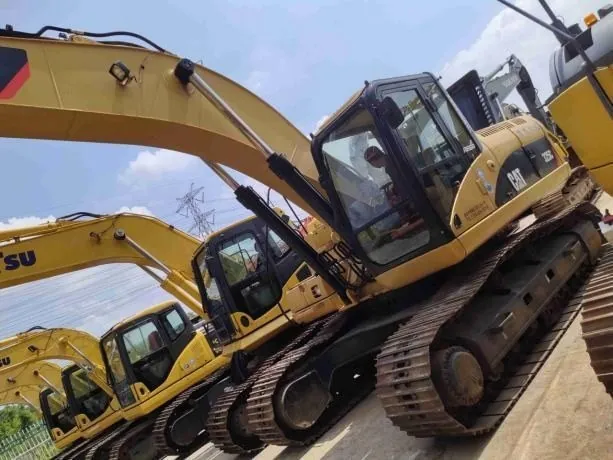
In short: how we work with you
- You contact us. Either you have already found the machine with a supplier or company, or we recommend one of the suppliers we have worked with before and stand behind, which lowers your risk.
- You tell us where the machine is, and we give you the exact full cost before we start, because the inspection cost depends on the location and travel.
- We contact the supplier, inspect the machine on site and send you a professional third-party inspection report with photos and videos, like the samples in this guide.
- If the machine is right for you, we sign a formal contract with the supplier in our name, as the party in China, on your behalf.
- We supervise loading to make sure the machine we inspected and paid for is the one that ships.
- We ship the machine to you and stay with you after the sale, including spare parts.
Why buyers source used machines from China
China has become a major market for used construction machinery. Dealer yards in Shanghai and across East China hold large stocks of excavators, loaders, skid steers and cranes from Caterpillar, Komatsu, Hitachi, Kubota and Case, next to newer Chinese brands such as Sany and SDLG.
What makes it attractive:
- Choice in one place. Dozens of the same model can sit in neighbouring yards, so you can compare hours, condition and price in one trip.
- Price. A well-kept used machine usually costs a fraction of a new one, and Chinese brands add a lower-cost option.
- Export experience. Yards and freight forwarders ship to the Middle East, Africa, Latin America and beyond every week.
What goes wrong when nobody checks:
- Fresh paint hides problems. A new coat of paint can cover cracks, welds, rust and oil leaks.
- Hour meters can't be trusted. Meters get replaced, reset or simply stop working.
- Nameplates are missing or don't match. Without a clear serial number, you can't confirm the year, the model or the machine's history.
- You receive a different machine. In one of our inspections, a supplier presented a Komatsu PC220 in place of the PC400-7 the buyer had ordered.
- Promised parts aren't there. Spare parts, attachments and documents are agreed by phone but missing on site.
Photos and videos sent by a seller are not an inspection. An independent inspector who stands next to the machine, starts it, works it and photographs every system is the only reliable way to know what you're paying for.
Machines we source and inspect
We inspect and source most types of used earthmoving and lifting equipment. The table shows the machines buyers ask us about most often, with what we focus on for each type.
| Machine type | Brands and models we often handle | Typical jobs | What our inspector focuses on |
|---|---|---|---|
| Crawler excavators (20–45 t) | CAT 320, 325, 330, 336 · Komatsu PC200, PC220, PC300, PC400, PC450 · Hitachi ZX200, ZX350 · Sany SY215, SY365 | Earthworks, quarries, mining, demolition | Engine, main pump, swing bearing, boom and arm cracks, undercarriage wear |
| Mid-size excavators (12–15 t) | Hitachi ZX135 · CAT 312, 313 · Komatsu PC130 · Sany SY135 | Roadwork, utilities, city sites | Short-tail counterweight damage, swing play, pins and bushings |
| Mini excavators (1–6 t) | Kubota U35, KX series · Sany SY35, SY60 · CAT 303, 305 | Landscaping, trenching, farms, tight spaces | Rubber tracks, swing boom, blade, engine smoke, hydraulic hoses |
| Skid steer loaders | Case 440 · Bobcat S-series · CAT 226, 246 | Material handling, site cleanup, attachments | Lift-arm pins, drive chains, hydrostatic drive, tyres, quick-attach plate |
| Wheel loaders | SDLG L956F, LG936 · CAT 950, 966 · Komatsu WA380 | Loading trucks, aggregates, ports | Transmission, articulation joint, bucket teeth, axle leaks |
| Truck-mounted cranes | XCMG QY25K · Zoomlion and Sany 25–50 t · Tadano and Kato | Lifting on construction and industrial sites | Boom sections, wire rope, outriggers, load-moment indicator, truck chassis |
If your machine isn't on this list, ask us. If it is in China, we can usually find, inspect and ship it.
Brand and model guide
Every brand has its own weak points. Here is what our inspectors look at first on the machines buyers ask about most.
Caterpillar (CAT 320, 325, 330, 336)
Older CAT excavators such as the 325C are still in high demand because they are simple to repair and parts are easy to find worldwide.
- Check first: swing bearing and its bolts, main hydraulic pump, engine blow-by and smoke, boom and arm welds.
- Watch for: missing engine nameplates, worn or uneven track shoes, rust under fresh paint.
- In our CAT 325C inspection in Shanghai (3,062 working hours), every function test passed, but we found an oil leak at the swing bearing, missing bolts and heavy rust. The buyer received this before paying, not after the machine arrived.
CAT models we handle most often:
| Type | Models |
|---|---|
| Mini excavators | 303, 305.5E2, 306, 307, 308 |
| Mid-size excavators | 312C, 312D, 313D2, 315D, 318D |
| Excavators (20–25 t) | 320C, 320D, 320D2, 320GC, 323D, 324D, 325C, 325D |
| Large excavators | 329D, 330C, 330D, 336D, 336D2, 349D |
| Wheel loaders | 950H, 962H, 966H, 980H |
| Bulldozers | D6R, D7R, D8R |
| Motor graders | 140H, 140K |
| Backhoe loaders | 416E, 420F, 428F |
| Skid steers | 226B, 246C, 262D |
Komatsu (PC200, PC220, PC400-7, PC450-7)
Komatsu excavators are among the most common used machines in China. The PC200 and PC220 are mid-size workhorses, while the PC400-7 and PC450-7 are big machines for heavy earthmoving and quarry work.

- Check first: the product identification number (PIN) on the nameplate against the model ordered. Similar-looking models are easy to swap.
- Watch for: cracks at the boom foot and bucket linkage, peeling paint over rust, dents on the bucket and side covers.
- Our finding: in this inspection the buyer had ordered a PC400-7 and a PC450-7. The yard presented a PC220 instead of the PC400-7. Only an on-site check against the order caught it.
Komatsu models we handle most often:
| Type | Models |
|---|---|
| Mini excavators | PC55MR, PC60-7, PC78US |
| Mid-size excavators | PC120-6, PC130-7 |
| Excavators (20–25 t) | PC200-7, PC200-8, PC210-8, PC220-7, PC220-8, PC240 |
| Large excavators | PC300-7, PC350-7, PC360-7, PC400-7, PC450-7, PC450-8 |
| Wheel loaders | WA320, WA380-3, WA380-6, WA470 |
| Bulldozers | D65, D85, D155 |
| Motor graders | GD511, GD555 |
Hitachi ZX135
The Hitachi ZX135US is a short-tail excavator of about 13 tonnes with roughly 125 hp, digging to around 5.5 m. Its compact rear makes it popular for roadwork and city sites.
- Check first: the counterweight and rear corners (short-tail machines often hit walls), swing gearbox, hydraulic pump response.
- Watch for: play in the swing circle, bent or re-welded arm, weak travel motors.
Hitachi models we handle most often:
| Type | Models |
|---|---|
| Mini excavators | ZX55U, ZX70 |
| Mid-size excavators | ZX120, ZX130, ZX135US |
| Excavators (20–25 t) | ZX200-3, ZX210, ZX240 |
| Large excavators | ZX330, ZX350, ZX360, ZX470, ZX870 |
Kubota U35
The Kubota U35 is a compact-tail mini excavator of about 3.7 tonnes with a 28 hp engine and roughly 3.1 m digging depth. It is one of the most requested minis for landscaping, utilities and farms.
- Check first: rubber track condition, swing boom (offset) pivot, dozer blade cylinder, engine starting and smoke.
- Watch for: cracked rubber tracks, leaking pilot hoses, worn bucket pins, hour meters replaced with a new cluster.
Kubota models we handle most often:
| Type | Models |
|---|---|
| Compact-tail mini excavators (U series) | U17, U27-4, U35, U35-4, U48-4, U55-4 |
| Conventional mini excavators (KX series) | KX018-4, KX033-4, KX040-4, KX057-4, KX080-4, KX161 |
| Compact track loaders | SVL75, SVL95 |
| Skid steers | SSV65, SSV75 |
Case 440 skid steer
The Case 440 (Series 3) is a large-frame skid steer of about 3.2 tonnes with around 84 hp and a rated operating capacity of about 1,000 kg. It runs a wide range of attachments: buckets, forks, breakers and sweepers.
- Check first: lift-arm pivot pins and bushings, drive chains in the chain case, hydrostatic drive pumps, quick-attach plate.
- Watch for: stretched chains (a knocking noise when turning), weak lift under load, cracked loader arms, worn tyres.
Case models we handle most often:
| Type | Models |
|---|---|
| Skid steers (classic series) | 410, 420, 430, 440, 445, 450, 465 |
| Skid steers (newer series) | SR175, SR210, SR250, SV280, SV300 |
| Compact track loaders | TR270, TR320, TV380 |
| Backhoe loaders | 580L, 580 Super N, 590 Super N |
| Excavators | CX130, CX210, CX240, CX350 |
| Wheel loaders | 621F, 721F |
Sany and SDLG
Chinese brands give buyers newer machines for less money. Sany excavators (SY35 to SY365) and SDLG wheel loaders (LG936, L956F) are widely available, and parts are easy to source in China.
- Check first: working hours in the electronic monitor, not just the meter. Check the engine brand and model against the spec sheet.
- Watch for: machines used hard in quarries or tunnels, then repainted and sold as "low hours".
Sany and SDLG models we handle most often:
| Brand and type | Models |
|---|---|
| Sany mini excavators | SY16C, SY26U, SY35U, SY55C, SY60C, SY75C, SY95C |
| Sany excavators | SY135C, SY215C, SY235C, SY265C, SY365H, SY485H, SY500H, SY750H |
| Sany truck cranes | STC250, STC500, STC750 |
| SDLG wheel loaders | LG918, LG936L, LG946L, LG953, LG956L, LG958L, L956F, L968F |
| SDLG excavators | LG6150E, LG6210E, E6135F, E6210F, E6250F |
| SDLG motor graders | G9190, G9220 |
Truck-mounted cranes (XCMG, Zoomlion, Sany, Tadano, Kato)
A truck crane is two machines in one: a crane and a road truck. Both need checking. Common used models include the XCMG QY25K and 25–50 tonne units from Zoomlion and Sany, next to Japanese Tadano and Kato cranes.
- Crane: extend and retract every boom section, check the wire rope for broken strands and kinks, test the hook block, slewing ring and winch brakes.
- Safety systems: load-moment indicator, limit switches and alarms must work. A crane without a working limit system should not be shipped as-is.
- Outriggers: full extension, no drifting under load, no leaking cylinders.
- Truck: engine, gearbox, brakes, steering, tyres and mileage. Truck cranes are registered vehicles, so the export paperwork needs extra care.
Crane models we handle most often:
| Brand and type | Models |
|---|---|
| XCMG truck cranes | QY25K, QY25K5, QY50K, QY70K, XCT25, XCT55 |
| Zoomlion truck cranes | QY25V, QY50V, ZTC250, ZTC550 |
| Sany truck cranes | STC250, STC500, STC750 |
| Tadano and Kato (Japanese) | Tadano GR-250N, GR-500EX · Kato KR-25H, NK-250 |
| Truck-mounted loader cranes (crane on a cargo truck, 3–16 t) | XCMG SQ series · Unic URV series · Palfinger |
Our inspection checklist, system by system
Our inspector goes through every machine in the same order, so nothing is skipped and every report can be compared. Each point is photographed, and the function test is filmed.
Step 1: Confirm it is the right machine. Before anything else, we match the machine to your order: brand, model, serial number (PIN) and working hours.

Step 2: Check every system. Then we work through the machine from the engine to the cab.

| System | What we check | Typical red flags |
|---|---|---|
| Identity and papers | Nameplate, PIN, engine number, year, hour meter, ownership documents | Missing or loose nameplate, PIN that doesn't match the model, hours that don't match the wear |
| Engine | Cold start, idle and full-throttle sound, exhaust smoke, blow-by, oil and coolant condition, leaks | Blue or black smoke, heavy blow-by from the breather, oil in coolant, hard starting |
| Hydraulics | Main pump, control valve, cylinders, hoses; cycle speed of boom, arm and bucket | Slow or weak movement, drifting cylinders, leaking seals, recently replaced hoses on only one side |
| Swing system | Swing bearing, swing motor and gearbox, bearing bolts, slewing play | Oil around the bearing, missing bolts, knocking when stopping a swing |
| Undercarriage | Track shoes, links, rollers, idlers, sprockets, track tension; shoe width measured | Uneven or polished shoes, worn sprocket teeth, leaking rollers, cracked track frame |
| Structure | Boom, arm, bucket, pins and bushings, counterweight, main frame | Cracks, fresh welds, plates added to hide repairs, excessive pin play |
| Electrical and cab | Monitor, warning lights, A/C, wipers, lights, horn, seat, glass | Fault codes, dead gauges, broken glass, missing panels |
| Function test | Travel forward and back, turning, full swing, full dig cycle, lifting, filmed on video | Hesitation, overheating, warning alarms during work |
| Measurements | Track shoe width, bucket width, key dimensions on request | Size different from the spec sheet you were given |
On request, we can also take engine oil samples for lab analysis, check fault codes with a diagnostic tool, or run a crane load test with a test weight.
What real inspections find
Both machines below started and ran normally in the function test, so at first glance they looked fine. But the full inspection found problems in each that seller photos would never show: the first needed repairs before it could be accepted, and the second was rejected outright. These photos come straight from two of our reports.
Case 1: CAT 325C excavator, Shanghai
Result: PENDING. The machine worked well, but it could only be accepted once the defects below were repaired. The report listed the repairs needed before the buyer paid.

A swing-bearing leak and missing bolts are repair costs the buyer can negotiate off the price, or ask the seller to fix before loading. Found after arrival, they come out of the buyer's pocket.
Case 2: Komatsu PC220 and PC450-7
Result: FAILED. The machines were rejected outright: we found 12 major and 7 minor defects, and one machine was the wrong model.


The buyer had also asked for replaced filters, correct serial numbers, the year of production and rust-proof wrapping for shipping. Our report answered each request with Passed, Failed or Pending, so the buyer knew exactly what to go back to the supplier with.
What our inspection report looks like
You get a clear PDF report, usually 20–30 pages, that you can read in five minutes and forward to your bank, partner or end customer. Buyer and supplier names are kept confidential, as in the samples below.


Every report includes:
- A one-page summary. Machine details, an overall result (Passed, Failed or Pending) and the key remarks, so you can decide at a glance.
- Results by category. Quantity, workmanship, function test, packing and your own special requirements, each marked clearly.
- A defect list. Each defect is classified as critical, major or minor, following the ANSI/ASQ Z1.4 inspection standard.
- Numbered photos. Often 100 to 200 photos, grouped by system: identification, exterior and undercarriage, engine, hydraulics, cab.
- Videos. The function test and a walk-around, sent with the report.
Reports are written in English with a bilingual Chinese–English header, and we also write them in Arabic for buyers who prefer it.
Our services
You can use us for one step or for the whole purchase, from finding the machine to delivering it to your port or your door.
1. Third-party inspection of a machine you found
You found a machine online or through a dealer. We go to the yard, inspect it with the checklist above and send you the full report, photos and videos. We work for you, not for the seller, and we have no stake in whether you buy.
2. Supplier verification and contracting
Before you send money to a supplier you have never met, we check:
- The company. Business licence, registration status and how long it has traded.
- The machine's ownership. That the seller actually owns or controls the machine they are offering.
- The contract. We sign the sales contract in our name, as the party in China, on your behalf, in Chinese and English, with the agreed machine, condition, price, payment terms and delivery date written down.
- Payment. We advise on safe payment steps, for example a deposit, then the balance after inspection and loading.
3. Loading supervision
A machine can pass inspection and still be swapped, damaged or loaded badly. Our inspector returns on loading day to:
- confirm the machine being loaded is the one that was inspected, by serial number;
- photograph it before and after loading;
- check lashing, blocking and protection in the container, flat rack or on the ship;
- confirm that agreed parts, attachments and documents go with it.
4. Sourcing from our trusted suppliers
Don't have a machine yet? Since 2011 we have worked with a network of used-equipment yards and dealers across China. These are suppliers we have worked with before and stand behind, which lowers your risk. Tell us the model, year range, hours and budget, and we shortlist machines, inspect them and send you the options with reports.
How a purchase works with us
- Your request. You send us the model, budget and destination. If you have already found the machine with a supplier or company, send us their details. If not, we recommend suppliers we have worked with before and stand behind. Buying from a supplier we already know lowers your risk.
- A full quote before we start. We first ask where the machine is, because the inspection cost changes from city to city with distance and travel. Then we give you the exact full cost, with no surprises later.
- Supplier contact and inspection. We take the supplier's details, contact them directly, arrange the visit and inspect the machine on site with the checklist above.
- Your decision. You receive a professional third-party inspection report in English or Arabic, like the samples above, with photos and videos, and decide: buy, negotiate or walk away.
- A formal contract with the supplier. Once you approve, we sign a formal contract with the supplier in our name, as the party in China, on your behalf. It fixes the machine, its condition, the price, payment terms and delivery date.
- Loading supervision. We are there at loading to make sure the machine we inspected and paid for is the one that leaves.
- Shipping to you. We arrange shipping by sea, including DDP delivery to many destinations.
- After-sales follow-up. We stay in touch after the machine arrives. If you need any after-sales service or spare parts for your heavy equipment, we source them in China.
Shipping used heavy equipment from China
The right shipping method depends mostly on the machine's size and weight, and on the services available to your port.
| Machine | Usual shipping method | Notes |
|---|---|---|
| Mini excavators (Kubota U35 class), skid steers (Case 440 class) | 20' or 40' HQ container | Several small machines can share one container to cut cost per unit |
| Mid-size excavators (12–22 t) | Flat rack container | Bucket and sometimes arm removed, machine lashed and blocked |
| Large excavators (30 t and above) | Flat rack, RoRo or break-bulk | May need partial dismantling: bucket, arm, counterweight |
| Wheel loaders, truck cranes | RoRo where available, otherwise flat rack or break-bulk | Truck cranes are driven on and off; check road-vehicle import rules at destination |
Before you buy, check two things for your country:
- Age and condition rules. Some countries limit the age of imported used machinery or require a pre-shipment certificate. We can help you check before you commit.
- Cleaning. Some destinations reject machines with soil or plant material on them. We arrange washing before loading when needed.
We ship by sea from Chinese ports and offer DDP (delivered duty paid) to the UAE, Saudi Arabia, Turkey, Europe, the UK, Canada, the USA and Latin America, so the price you agree covers the machine all the way to you.
Frequently asked questions
Can you inspect a machine I found myself?
Yes. Send us the listing or the seller's contact and the machine's location. We arrange the visit with the seller and inspect on your behalf.
Do I need to travel to China?
No. Our report, photos and videos let you decide from your office. Many of our buyers never visit the yard.
Can you tell if the hour meter was changed?
Not always with certainty. We compare the meter with the machine's own monitor records and with wear on pins, pedals, seat, controls and undercarriage. When the hours and the wear don't match, the report says so clearly.
What if the machine fails the inspection?
You decide. You can negotiate the price, ask the seller to repair and have us re-inspect, or walk away before paying the balance. That is the point of inspecting before payment.
Can you inspect several machines in one visit?
Yes. In the Komatsu case above, we inspected two excavators in one visit and reported on each one separately.
Do you also inspect truck cranes and wheel loaders?
Yes. Truck cranes get two checks: the crane (boom, rope, outriggers, safety systems) and the truck (engine, gearbox, brakes, papers).
Can I get the report in Arabic?
Yes. Our team includes Arabic speakers, so we can write the report in Arabic, English, or both, and discuss the findings with you by phone or WhatsApp in Arabic.
Contact us
Tell us the machine you want, or send us the one you found. We'll reply with the next steps and a quote for inspection, sourcing or shipping.
- WhatsApp: +86 185 2028 8213
- Email: sales@chinaurora.com
- Website: www.chinaurora.com
- Office: Guangzhou Aurora Trading Co., Ltd. (广州艾禄光贸易有限公司), Nanzhou Road 183, Haizhu District, Guangzhou, China
Guangzhou Aurora Trading has provided sourcing, quality inspection and freight logistics from China since 2011.
Sources
Machine specifications quoted above are approximate and vary by version and options:
- Hitachi ZX135US-3 specifications (RitchieSpecs)
- Kubota U35 specifications (RitchieSpecs)
- Case 440 Series III specifications (RitchieSpecs)